
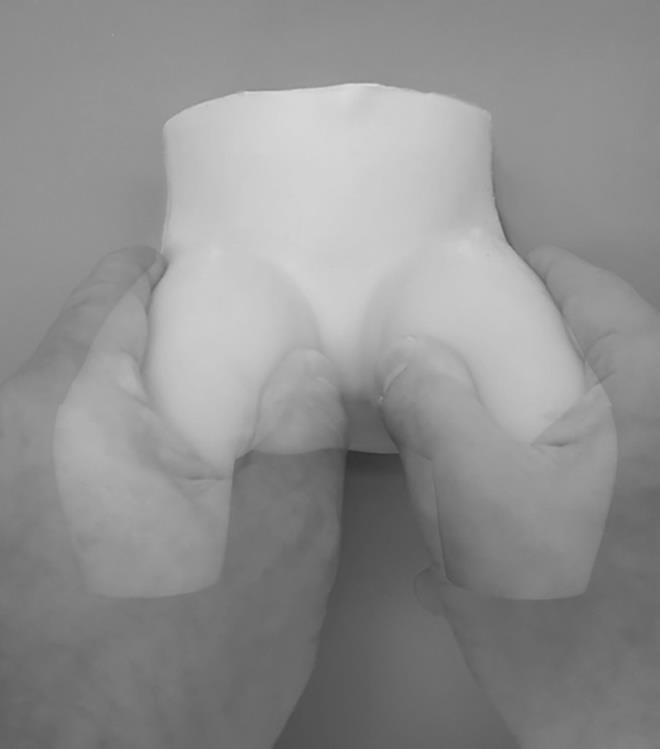
Mi-Hip Newborn Hip Exam Trainer

$1,799.00

The Mi-Hip Newborn Hip Exam Trainer is a developmental dysplasia of the hip (DDH) task trainer that replicates the Barlow and Ortolani maneuvers, the core of the newborn hip examination, across four model variants. Developed by a multidisciplinary University of Michigan team and studied in U-M's pediatrics and family medicine residencies, it comes with peer-reviewed evidence that skills learned on the model carry over to real newborn exams.

Most residents learn the newborn hip exam at the bedside, if a DDH-positive baby happens to show up. Many finish training without ever feeling a positive hip. Mi-Hip puts the full diagnostic spectrum, normal, left positive, right positive, and bilateral positive, in every learner's hands before they touch a patient.

88.9%
Agreement with hip ultrasound for residents trained on Mi-Hip, vs 25.0% for untrained practicing physicians (Gupta et al., Academic Pediatrics, 2025)
23%
Fewer unnecessary DDH ultrasound referrals after one 30-minute session per resident (Patel et al., under review at Surgery)
4
Model variants, so learners examine the full diagnostic spectrum blind instead of pattern-matching

The Exam

Barlow and Ortolani, on four models.

RLBilateral normalBoth hips normal
RLLeft positiveLeft hip DDH-positive, right normal
RLRight positiveRight hip DDH-positive, left normal
RLBilateral positiveBoth hips DDH-positive
1. Barlow Maneuver
Provocative test: detecting a dislocatable hip
2. Ortolani Maneuver
Reduction test: the clunk of a dislocated hip relocating
3. Recognizing the Clunk
An unambiguous clunk when the maneuver is performed properly, at the force appropriate for a real infant
4. Correct Hand Placement
Examiner hand position for both maneuvers
5. Blinded Diagnosis
Learners examine all four variants without knowing which one they hold
6. Deciding When to Refer
Reading the finding on each hip and deciding whether it needs imaging or specialist referral

The positive models are built to present an unambiguous clunk when the maneuver is performed correctly, at realistic examination force. In the published University of Michigan study, residents' knowledge, diagnostic accuracy on the models, and confidence in both simulated and clinical settings all improved after training, and the study captured 1,063 real newborn exams on the clinical service (Gupta et al., Academic Pediatrics, 2025).

Mi-Hip newborn hip model with the examiner's hands in position for the Barlow and Ortolani maneuvers
Correct examiner hand placement on Mi-Hip. Figure 1 from Gupta et al., Academic Pediatrics, 2025.

The Models

Built to teach feel, not visual cues.

A DDH-positive hip is a tactile finding. Each Mi-Hip positive model produces a clear clunk when the Barlow or Ortolani maneuver is performed correctly, at realistic examination force. Four variants cover the diagnostic spectrum, so learners cannot pattern-match on a single fixed configuration: they have to examine, decide, and compare against the other hip.

What's included: four newborn hip models (bilateral normal, bilateral positive, unilateral left positive, unilateral right positive), a user manual, and a warranty card. No consumables or replacement parts are required. Ships from Ann Arbor, Michigan.

Request a Quote →

The Team and the Evidence

Developed at the University of Michigan

Mi-Hip began in the clinic, not a catalog. Clifford L. Craig, MD, spent his career in pediatric orthopaedics at the University of Michigan, where he directed the orthopaedic surgery clerkship for nearly 19 years and saw the same gap year after year: new physicians expected to catch hip dysplasia with an exam they had rarely practiced. He joined a U-M team of pediatricians, medical educators, and biomedical engineers building a trainer to close that gap, and used it to teach his own learners at Michigan. Mi-Hip is that trainer, now validated in peer-reviewed research.

Clifford L. Craig, MD
Pediatric orthopaedic surgeon; Clinical Associate Professor Emeritus of Orthopaedic Surgery, University of Michigan
Co-developer of Mi-Hip and instructor in both studies
Deborah Rooney, PhD
Director of Education and Research in Simulation, U-M Clinical Simulation Center
Co-author of both Mi-Hip studies

The Evidence

Both studies come from the University of Michigan, where the training was delivered in the pediatrics and family medicine residency programs.

2025
Simulation-based training improves developmental hip dysplasia examination and diagnosis skills on newborns.
Gupta S, Patel K, Craig CL, Nemetz T, Skoczylas M, Burrows H, Rooney DM. Academic Pediatrics. 2025. Trained residents' diagnoses agreed with hip ultrasound 88.9% of the time vs 25.0% for untrained practicing physicians (P = 0.003). The study captured 1,063 real newborn exams on the clinical service.
Read the study (DOI)
UNDER REVIEW
Simulation-based training reduces unnecessary ultrasound referrals for developmental dysplasia of the hip in newborns.
Patel K, Fullano GD, Sickmiller L, Wang M, Yassin M, Craig CL, Skoczylas M, Burrows HL, Rooney DM. Under review at Surgery, 2025. In the 12 months after resident training, unnecessary DDH ultrasound referrals fell from 70.8% of referrals to 54.5% (P = 0.04) across nearly 10,000 newborns.
Citation will be updated on publication.

Questions

Common questions

What is included?
Four newborn hip models covering the diagnostic spectrum: bilateral normal, bilateral positive, unilateral left positive, and unilateral right positive, plus a user manual and warranty card. There are no consumables or replacement parts.
Why four model variants?
So learners can be tested blind. With a single fixed configuration, a trainee quickly learns which hip is "the bad one" and stops examining. With four variants, including a fully normal pair, they have to perform the maneuvers and read the finding every time. Blinded diagnosis across all four models is part of the training protocol used in the published study.
Is there evidence the skills transfer to real patients?
Yes. In a peer-reviewed University of Michigan study of 54 pediatrics and family medicine residents, trained residents' DDH diagnoses agreed with hip ultrasound 88.9% of the time, compared with 25.0% for practicing primary care physicians who had not trained (P = 0.003). The study captured 1,063 real newborn exams on the clinical service (Gupta et al., Academic Pediatrics, 2025). The study was run at a single institution and was not randomized.
Does it change referral patterns?
A follow-up study at the same institution, currently under review at Surgery, compared DDH ultrasound referrals in the 12 months before and after resident training. Unnecessary referrals (DDH-negative on ultrasound) fell from 70.8% of referrals to 54.5%, and overall DDH referrals fell 34% (Patel et al., under review). We will update this page when the paper is published.
Who is it for?
Programs that teach the newborn hip exam: pediatrics and family medicine residencies, neonatal-perinatal fellowships, medical student clerkships, and newborn nursery teams. The published study trained first- and second-year residents; an earlier pilot trained 222 medical students.
Is a curriculum included?
The training protocol used at the University of Michigan is described in the published study: pre-work reading and video, a 30-minute hands-on session, and blinded diagnosis across all four models. Contact us and we will share the protocol outline with your program.
How does shipping work?
Mi-Hip ships from Ann Arbor, Michigan. Lead time is confirmed at quote. For international orders or institutional purchasing, request a quote.