
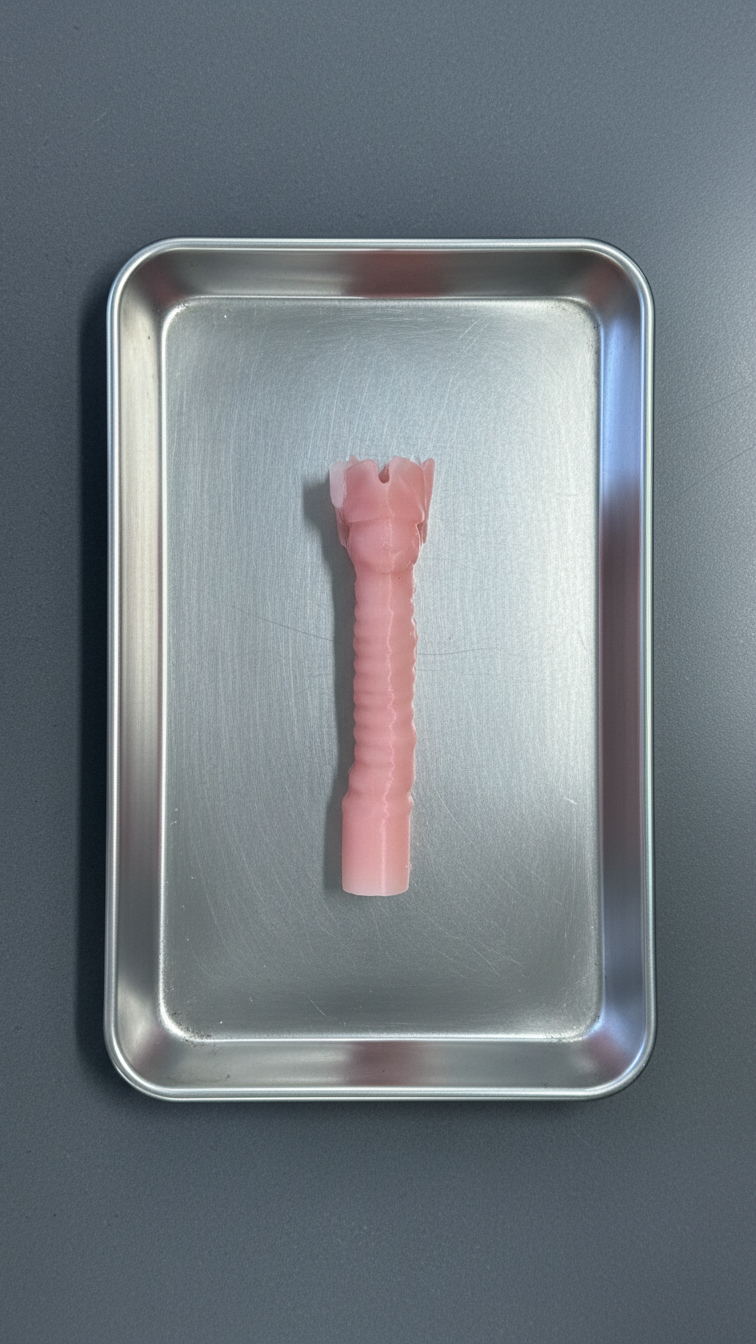
 Image 1 of 3
 Image 2 of 3
 Image 3 of 3
Diagnostic accuracy after simulator-based training
Peer-reviewed validation studies
Anatomy variants: healthy and subglottic stenosis
Core Skills Trained
Emergency surgical airway technique
Percutaneous airway access
Reconstructive airway surgery
Open airway reconstruction
Diagnostic evaluation workflow
Flexible and rigid scope practice
The Pediatric Airway Simulator is a high-fidelity procedural task trainer built for visual and anatomical accuracy, with realistic tissue dynamics. It supports practice of life-saving front-of-neck access (FONA) procedures, including needle cricothyroidotomy, as well as complex airway reconstruction work like slide tracheoplasty and laryngotracheal reconstruction.
Two anatomic variants ship in every kit. The Healthy variant provides normal pediatric tracheal anatomy for baseline technique. The Stenosis variant recreates subglottic narrowing for reconstructive training and diagnostic practice.
Each simulator is produced from CT-derived geometry using a silicone process designed to reproduce real airway anatomy and tissue feel.
What's included: One Pediatric Airway Simulator in your selected variant, a mounting stand, and a quick-start card. Ships from Ann Arbor, MI.
Pricing for residency programs and surgical training courses includes volume discounts.
Request a Volume Quote →Peer-Reviewed Publications
The most-published simulator in the Makemedical line. Three clinical validation studies across emergency access, reconstruction, and fellowship training.
2020
Development and Multidisciplinary Preliminary Validation of a 3-Dimensional-Printed Pediatric Airway Model for Emergency Airway Front-of-Neck Access Procedures.
Kovatch KJ, Powell AR, Green K, et al. Anesthesia & Analgesia.
PubMed →2019
Development of a high fidelity subglottic stenosis simulator for laryngotracheal reconstruction.
Reighard CL, Green K, Powell AR, Rooney DM, Zopf DA. International Journal of Pediatric Otorhinolaryngology.
PubMed →2018
A multidisciplinary international collaborative implementing low cost 3D printed airway models.
Zopf DA, Hollister SJ, et al. International Journal of Pediatric Otorhinolaryngology.
PubMed →